1. Concept extracted
The work describes several core conceptual processes:
Concept: Displacement and bureaucratic processing/Human → data transformation/Circuit as connection and surveillance/Human-machine hybrid/Identity continuously updating
Explanation:
Human identity being processed by systems/Face becoming pixels / data/Networks and electronics as metaphors/Biological + digital systems/System state constantly recalculated
These motifs appear throughout the introduction and artistic statement.
2. Designed Electronic System
Name of circuit:
Identity Processing and Displacement Mapping Circuit (IPDMC)
The circuit simulates the conceptual transformation described in the PDF.
Functional blocks
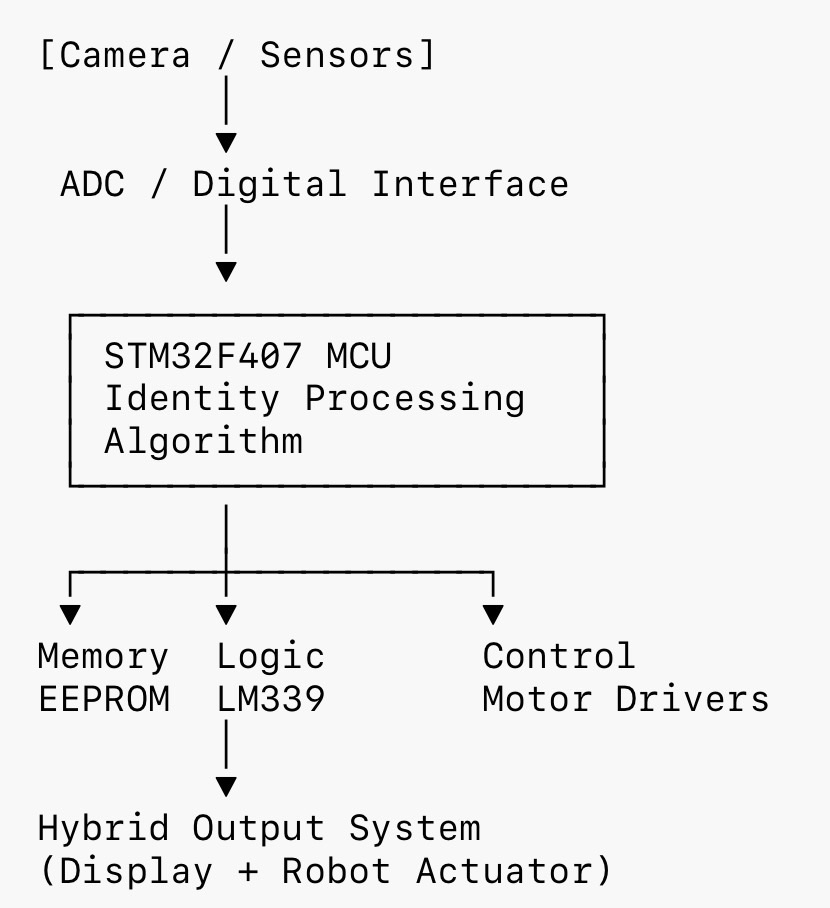
Human Input (sensor) Data Conversion Identity Processing Core Memory / Bureaucratic State Hybrid Output (machine + human representation)
3. Main IC (Equivalent to the core idea of the PDF)
Main IC
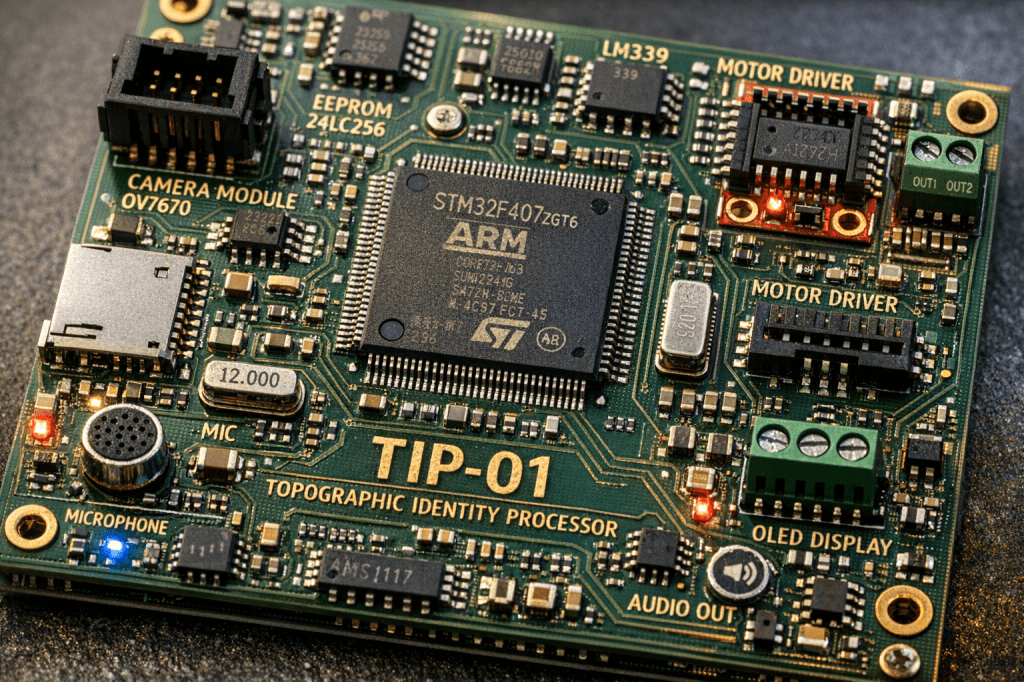
ARM Cortex-M4 Microcontroller (STM32F407)
Why this IC corresponds to the concept
The microcontroller acts like the “bureaucratic / algorithmic system” described in the work.
Idea:Identity processed by systems/Hybrid human-machin/Continuous updates of identity/Circuit as connection
Electronic Equivalent:Microcontroller processing sensor data/MCU controlling mechanical / digital outputs/Firmware loop updating state/MCU communication buses
The book explicitly references circuits and hybrid human-machine structures, making a microcontroller the conceptual center.
4. Complete Electronic Circuit Components
Input Layer (Human → Data)
Component:Camera Sensor (OV7670)/Microphone Sensor/Fingerprint Sensor
Function:Captures face/image/Voice identity/input/Identity authentication
Equivalent:Human identity becoming digital data/Personal presence/Bureaucratic identity verification
System Logic
Component:74HC595 shift registers/Comparator (LM339)/Analog multiplexer (CD4051)
Function:Expand outputs/Decision logic/Route signals
Concept:System bureaucracy/Acceptance / rejection/Border checkpoints
Memory / State (Identity Archive)
Component:EEPROM 24LC256/SD Card Module
Function:Identity records/Historical data
Output Layer (Human-Machine Hybrid)
Component:OLED Display/LED matrix/Stepper Motor/Speaker
Function:Visual identity rendering/Status of identity processing/Mechanical movement/Synthetic voice output
Symbol:Data representation/System signals/Robot body/Machine identity
5. Circuit Architecture
6. Synchronization with sections
SECTION I — Bodies and Borders
Electronic equivalent:
Sensors + Identity recognition
SECTION II — Myth and Memory
Equivalent:
EEPROM / SD card storage
Memory circuits store symbolic and historical data.
SECTION III — Cartographies
Equivalent:
GPS module + map processing
Mapping displacement spatially.
SECTION IV — Witness
Equivalent:
Camera + recording module
The system records events.
7. Process Performed by the Circuit
Algorithm
Capture human face Convert image to digital data Process identity Compare with stored data Generate hybrid output
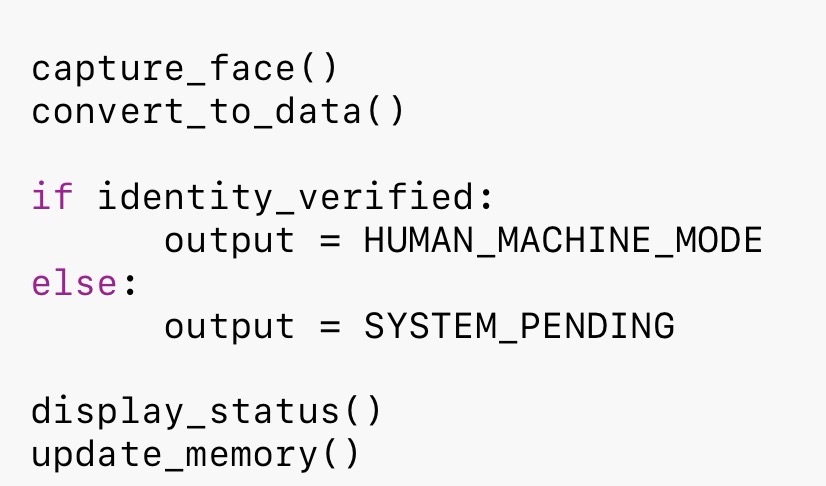
8. Result
The circuit performs the conceptual transformation described:
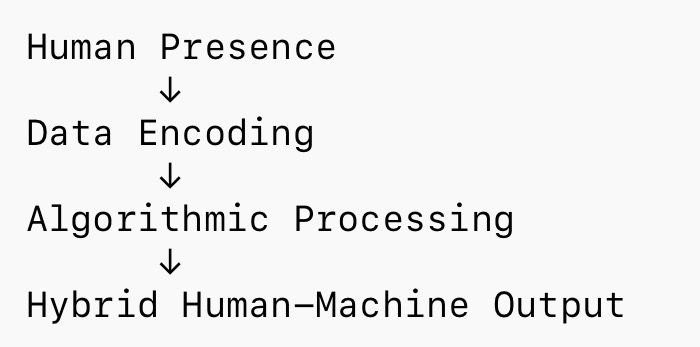
This directly reflects the work’s themes of identity processed by technological systems and hybrid human-machine existence.
9. If you want, I can also generate
• a full schematic diagram
• a KiCad PCB project file
• a Proteus simulation
• a research-paper style technical explanation of the circuit based on your book
1.Conceptual system architecture
2.Full circuit schematic
3.Component list
4.How each circuit block corresponds to parts of content
5.Files you can recreate in KiCad / Proteus
1. Conceptual Electronic System
System name
Algorithmic Identity Processing Circuit (AIPC)
Purpose:
Simulate the process described:
Human identity
↓
Digitization
↓
Algorithmic processing
↓
Hybrid human-machine output
This mirrors the transformation where a human face becomes data and merges with circuitry, as described in the project.
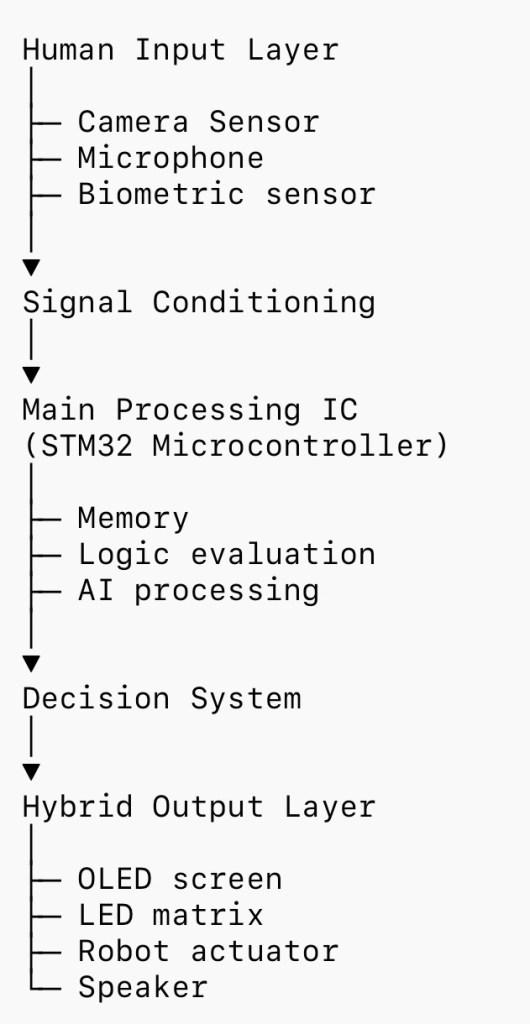
2. Complete System Architecture
3. Main IC (Central Processor)
STM32F407 Microcontroller
Reason:
PDF Concept
Human identity becomes data
Systems processing human status
Continuous identity update
Human-machine hybrid
Circuit Equivalent
Sensor → MCU processing
MCU algorithms
firmware loop
MCU controlling robot outputs
The MCU represents the algorithmic authority processing identity.
4. Full Circuit Schematic
Input Stage
code
Camera (OV7670)
DØ-D7 → STM32 GPIO
VSYNC
HREF
PCLK
Microphone
L LM358 Amplifier → ADC
Fingerprint Sensor
UART → MCU
Processing Stage
code
STM32F407
_ Clock Crystal 8MHZ
– Reset circuit
– Flash Memory
SPI / I2C buses
口
Memory Layer
code
EEPROM 24LC256
• I2C Bus
SD Card Module
SPI Bus
Concept:
This represents memory of identity and migration history.
Decision Logic
code
Comparator LM339
– Identity match
System
status
• Copy
Output Layer
code
OLED Display
L
I2C
LED Matrix
L
SPI
Motor Driver L298N
Stepper Motor
Audio DAC
Speaker
• Copy
The robot motion reflects hybrid human-machine identity.
5. Power Circuit
code
12V Power Supply
• Copy
LM2596 Buck Converter
3.3V regulator (AMS1117)
6. Component List (Sorted)
Core Processing
Component
Quantity
STM32F407
1
Crystal 8 MHz
Reset button
6. Component List (Sorted)
Core Processing
Component
Quantity
STM32F407
1
Crystal 8 MHz
1
Reset button
1
Sensors
Component
OV7670 Camera
Microphone
Fingerprint sensor
Logic
Component
LM339 Comparator
74HC595 Shift register
CD4051 Multiplexer
Memory
Component
EEPROM 24LC256
MicroSD module
Outputs
Component
OLED display
LED matrix
Stepper motor
Speaker
7. Correspondence with
Sections
SECTION I – Bodies and Borders
Equivalent hardware:
code
Biometric sensors
Identity scanning
Copy
These represent systems that measure and process human presence.
SECTION II – Myth and Memory
Equivalent hardware:
code
EEPROM
SD storage
This stores identity narratives.
) Copy
SECTION III – Cartographies
Equivalent hardware:
Equivalent hardware:
code
GPS module
Mapping display
Maps displacement.
• Copy
SECTION IV – Witness
Equivalent hardware:
code
Camera
Recording module
The system observes and records.
• Copy
8. Circuit Process
code
Human detected
Face captured
Identity encoded
Data stored
System decides status
Hybrid output generated
8. Circuit Process
code
Human detected
Face captured
Identity encoded
Data stored
System decides status
6 Hybrid
output generated
口 Copy
9. Installation / Exhibition Version
This circuit could be built as a gallery installation:
Physical structure:
code
Camera
Processing unit
Robot head with LEd face
Screen showing identity data
口 Copy
Visitors would be scanned and transformed into algorithmic identity.
…………………………………..
Primary Recommended Name
Displacement Identity Processor (DIP-01)
Meaning
Displacement → core concept of the book Identity → human data being processed Processor → microcontroller-based system
This name sounds like a real electronic device and also reflects the conceptual framework of the work.
Alternative Names
1. Circuit of Belonging
Inspired by the conceptual idea of identity processed through systems.
Meaning:
Human belonging represented as a circuit network.
2. Topographic Identity Engine (TIE-01)
Meaning:
Identity mapped like geography.
Connection to the book:
“Topographies” → spatial mapping.
3. Hybrid Identity Synthesizer (HIS-01)
Meaning:
Human + machine hybrid system.
4. Algorithmic Border Processor (ABP-01)
Meaning:
Systems deciding identity status.
5. Human-Machine Identity Mapper (HMIM-01)
Meaning:
Maps human identity into digital circuits.
Best Choice (Recommended)
Topographic Identity Processor — TIP-01
Why it works best:
Concept
Representation
Topographies
spatial mapping
Identity
human subject
Processor
electronic system
It also sounds like a scientific instrument or research device, which fits your project.
V Final suggested name:
TIP-01
Topographic Identity Processor
If you want, I can also design:
a professional PCB silkscreen logo
a device label for the board
a conceptual diagram for a research paper
a museum installation title for the circuit system
project could actually become a very strong media-art electronics installation, and the naming can strengthen that concept.
Legal Statement – Displacement Identity Processor (DIP-01)
Project by Farid Nazifi
Date: 10 March 2026
The project titled “Displacement Identity Processor (DIP-01)” constitutes a conceptual, artistic, and technological interpretation derived from the themes, narratives, and theoretical framework presented in the publication Topographies of Displacement: Collected Works 2024–2026 by Farid Nazifi.
This project translates the artistic concepts articulated in the publication—particularly those concerning displacement, bureaucratic identity systems, human–machine hybridity, memory, borders, and cartographic representations—into an experimental electronic and computational installation. The described circuitry, system architecture, and algorithmic processes serve as symbolic and interpretative representations of the conceptual ideas explored in the book rather than as literal reproductions of textual content.
The electronic system, referred to as the Displacement Identity Processor (DIP-01), is designed as a media-art apparatus that simulates the transformation of human identity into digital data through sensing, algorithmic processing, memory storage, and hybrid mechanical-digital output. All electronic components, schematic structures, firmware logic, and system architectures described within the project are original technical interpretations created to embody and materialize the conceptual framework of the artistic work.
This project does not reproduce, redistribute, or replicate substantial portions of the text or images from Topographies of Displacement: Collected Works 2024–2026. Instead, it operates as an independent artistic and technical extension, translating theoretical and visual themes into a new medium: electronic circuitry and interactive installation.
All conceptual content, artistic themes, and original works referenced remain the intellectual property of Farid Nazifi. The design of the DIP-01 circuit system, including schematic interpretation, component selection, firmware logic, and installation concept, is presented as part of an experimental artistic research project exploring the intersection of identity, technology, displacement, and algorithmic governance.
Any public presentation, exhibition, publication, or reproduction of this project should include proper attribution to:
Farid Nazifi
Topographies of Displacement: Collected Works 2024–2026
Leipzig, Germany
This statement affirms that the Displacement Identity Processor (DIP-01) is intended solely for artistic, research, and educational purposes within the fields of media art, electronic art, and critical technology studies.
© 2026 Farid Nazifi
All rights reserved.
 Farid NZ