📌 Numbered Parts and Detailed Explanation
1. Brain
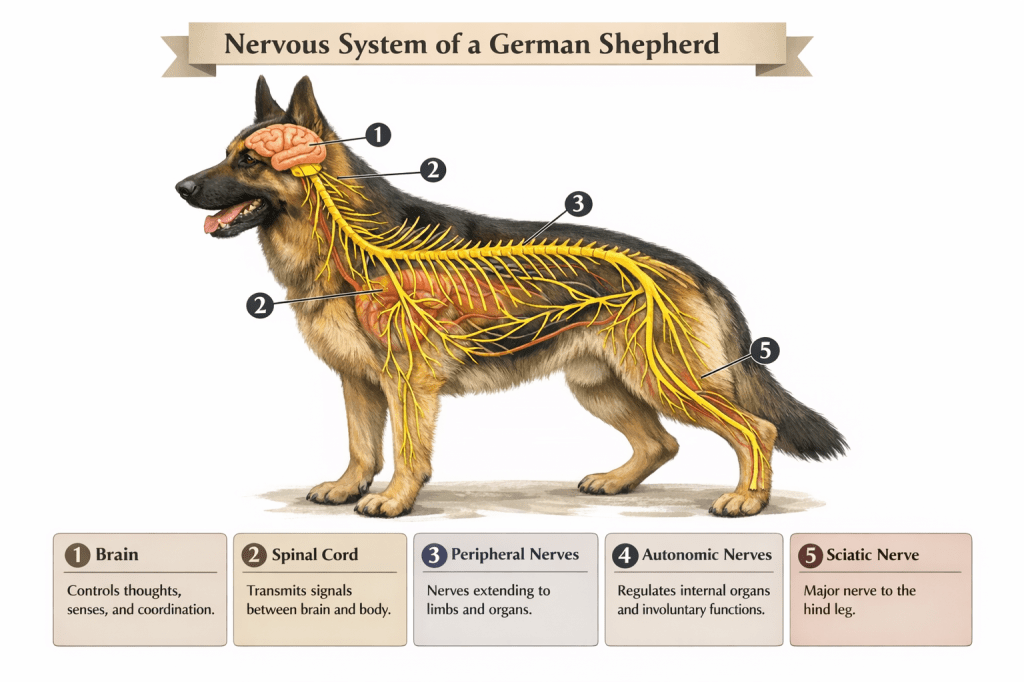
The brain is the control center of the German Shepherd’s entire body. It processes information from the senses (sight, smell, hearing, touch) and makes decisions.
Functions: Controls behavior, learning, memory, and emotions Coordinates movement and balance Processes sensory input (like recognizing smells or commands) Key Parts: Cerebrum: Thinking, memory, voluntary actions Cerebellum: Balance and coordination Brainstem: Basic life functions (breathing, heartbeat)
👉 German Shepherds are highly intelligent, and their brain allows them to learn commands quickly and work as police or service dogs.
2. Spinal Cord
The spinal cord is a long bundle of nerves that connects the brain to the rest of the body.
Functions: Sends signals from the brain to muscles (movement) Sends sensory information back to the brain Controls reflex actions (fast automatic responses)
👉 Example: If the dog steps on something sharp, the spinal cord triggers a quick withdrawal before the brain fully processes the pain.
3. Peripheral Nervous System (Peripheral Nerves)
This system includes all the nerves branching out from the brain and spinal cord to the rest of the body.
Functions: Carries messages to and from limbs, organs, and skin Helps the dog feel temperature, pain, and touch Controls voluntary movements like running or jumping
👉 These nerves allow a German Shepherd to react quickly to commands and move with precision.
4. Autonomic Nervous System
This part controls automatic (involuntary) functions that the dog does not consciously control.
Functions: Regulates heart rate, breathing, digestion Controls internal organs Maintains body balance (homeostasis) Two parts: Sympathetic system: “Fight or flight” (e.g., when alert or chasing) Parasympathetic system: “Rest and digest”
👉 This system keeps the dog alive and functioning without thinking about it.
5. Sciatic Nerve
The sciatic nerve is one of the largest and most important nerves in the hind leg.
Functions: Controls movement of the back legs Provides sensation to the hind limbs Helps with walking, running, and jumping
👉 Injury to this nerve can cause weakness or difficulty walking in the back legs.
🧾 Project Description (for school use)
This project explores the structure and function of the nervous system in a German Shepherd. The nervous system is responsible for communication throughout the body and allows the dog to respond to its environment.
The project includes a labeled diagram showing the five major components: brain, spinal cord, peripheral nerves, autonomic nervous system, and sciatic nerve. Each part plays a unique role in controlling movement, processing information, and maintaining vital body functions.
By understanding how these systems work together, we can better appreciate how German Shepherds perform complex tasks such as guarding, assisting humans, and learning commands. The nervous system is essential for both survival and behavior.
 Farid NZ